Pedagogy First: The Science Behind Happy Numbers K–5
Early math skills matter for the long term: research shows that children’s mathematical knowledge at school entry predicts later academic achievement (Duncan et al., 2007), while their progress from pre-K through first grade predicts math achievement through age 15 (Watts et al., 2014).
This is why technology has found its place in K–5 classrooms: to help every student stay on track. But moving worksheets onto a screen does not, by itself, improve outcomes.
Technology earns its place only when it is built around what learning science actually shows to be helpful: models children can build, feedback tied to the exact problem a student got wrong, individualized pacing, and fluency woven into a weekly rhythm.
This article explains how Happy Numbers does that — through three layers: pedagogy grounded in research, infrastructure that runs itself, and accessibility that lets every student in.
Layer 1 – Pedagogy
Conceptual Understanding: Laying the Foundation
How Children Learn Math
Children ages 4–11 acquire skills in mathematics through a well-documented progression: Concrete → Pictorial → Abstract (CPA), first described by Jerome Bruner. A child who builds 5 + 3 with blocks constructs a mental model of part-whole relationships, and the symbols they meet later map onto something they have already experienced. Research on “concreteness fading” shows that children are better able to apply what they learn to new problems when instruction moves gradually from concrete models to abstract symbols (Fyfe et al., 2015).
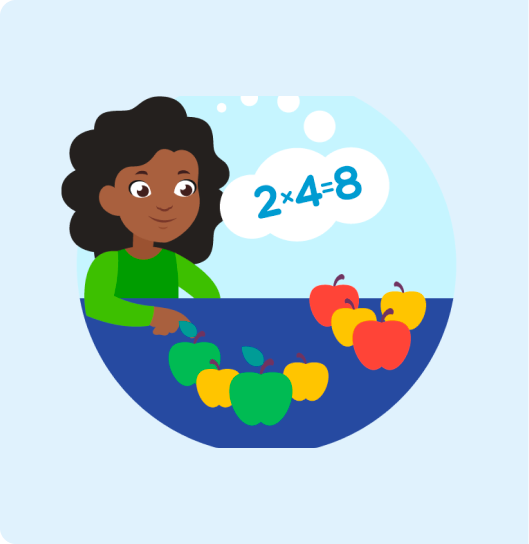
Happy Numbers puts model construction at the forefront: students grow their understanding of each concept with on-screen versions of the same manipulatives they use in class — real-world objects, linking cubes, and place value charts — before symbolic notation appears. The abstract comes after the concrete, not in place of it.
What We Don't Do
A common response to student errors in digital programs is to show a similar example, or simply reveal the correct answer. Young children may not yet be able to generalize, or see how a similar example applies to the problem in front of them (Richland et al., 2006; Dowker, 2014). Simply revealing the correct answer does even less to build understanding.
What We Do Instead
These findings shape how Happy Numbers responds to every mistake. Depending on the student's level and the concept's difficulty, the child uses a model to rebuild that specific problem directly, watches an animated model of it, or gets a simple hint when that's enough. The correction is always about this problem — not a similar one. And whenever the student is ready, they rebuild the problem themselves.
Fact Fluency: Taking Skills from Understanding to Automaticity
Conceptual understanding and fluency work together: efficient use of basic facts helps students tackle more complex math (National Research Council, 2001). Short, frequent practice can build addition-fact fluency more effectively than the same amount of practice completed in one longer session (Schutte et al., 2015).
Happy Numbers builds short fluency practice sessions into the weekly learning cycle, but these always come after conceptual work, not instead of it. This practice is adjusted to match each student’s curriculum progress and fact-level performance.
The path is individualized and mastery-based, with time pressure introduced gradually: students begin with untimed practice on a topic, move to gentle time pressure, then progress to mixed-fact practice. They advance only when they have mastered at least 85% of the facts within a topic and are ready for the next.
Engagement That Supports Focus
For young learners, engagement isn't optional — children learn best when they're curious and motivated. Happy Numbers uses game elements that students can really connect with: hatching dinosaur eggs, unlocking creatures, earning stars, and discovering new worlds as they progress.
But attention is a limited resource. Young children’s focus can be easily drawn to irrelevant visual elements (Fisher et al., 2014). Happy Numbers applies this principle to interface design: the screen stays clean during problem solving, so game elements reward progress without competing for the attention that belongs to the math.
Layer 2 – Infrastructure: Automatic Routines, Teacher Control
A supplemental math program should add to classroom instruction, not to the teacher's workload. Happy Numbers contributes its part automatically — so teachers can stay focused on teaching.
Individual Pace, Individual Path
Every student’s journey begins with an adaptive Placement Test designed to identify the right starting point in the curriculum while minimizing testing time. The pathway keeps students challenged without overwhelming or frustrating them - an approach based on Vygotsky’s zone of proximal development (1978).
Our scoring system ensures students spend the right amount of time on every exercise, so they can't click through without learning. Together, the Placement, Mid-Year, and End-of-Year assessments establish a starting point, track growth, and, when appropriate, refine the learning pathway.
A Weekly Routine on Autopilot
From the Placement Test onward, Happy Numbers coordinates the learning and fluency pathways in a weekly cycle. Teachers can monitor class and individual progress in Reports without manually assigning or scheduling each session.
Assignments and Printables: Flexibility Around the Core
The automatic core is complemented by tools teachers control. The skill report highlights each student's weak spots, and 1–2 targeted assignments a month strengthen exactly those skills. Happy Numbers printables extend practice beyond the screen, allowing teachers to alternate between screen-based and paper-based practice.
Layer 3 – Accessibility: Every Student Has Access to Math
Young children are often learning to read at the same time they're learning math — and for multilingual learners, language adds another barrier. Every ounce of effort spent decoding instructions is effort taken away from mathematical thinking. The National Academies' report, English Learners in STEM Subjects (2018), makes the case directly: reducing language barriers and including support in students' home languages are key to giving multilingual learners crucial access to math.
Happy Numbers is built accordingly. Instructions and explanations are read aloud for PK–1 learners, with voice-over on demand in older grades — so students can engage with math before they're fluent readers. Spanish-language support is available throughout, letting multilingual learners reason in a language they understand. And the platform is working toward WCAG 2.2 AA conformance, so that all students and educators can use it successfully.
The research behind this
Bruner, J. S. (1966). Toward a theory of instruction. Belknap Press of Harvard University.
Duncan, G. J., Dowsett, C. J., Claessens, A., Magnuson, K., Huston, A. C., Klebanov, P., Pagani, L. S., Feinstein, L., Engel, M., Brooks-Gunn, J., Sexton, H., Duckworth, K., & Japel, C. (2007). School readiness and later achievement. Developmental Psychology, 43(6), 1428–1446. doi: 10.1037/0012-1649.43.6.1428. Link
Watts, T. W., Duncan, G. J., Siegler, R. S., & Davis-Kean, P. E. (2014). What’s past is prologue: Relations between early mathematics knowledge and high school achievement. Educational Researcher, 43(7), 352–360. doi: 10.3102/0013189X14553660. Link
Fyfe, E. R., McNeil, N. M., & Borjas, S. (2015). Benefits of “concreteness fading” for children’s mathematics understanding. Learning and Instruction, 35, 104–120. doi: 10.1016/j.learninstruc.2014.10.004. Link
Richland, L. E., Morrison, R. G., & Holyoak, K. J. (2006). Children’s development of analogical reasoning: Insights from scene analogy problems. Journal of Experimental Child Psychology, 94(3), 249–273. doi: 10.1016/j.jecp.2006.02.002. Link
Dowker, A. (2014). Young children’s use of derived fact strategies for addition and subtraction. Frontiers in Human Neuroscience, 7, Article 924. doi: 10.3389/fnhum.2013.00924. Link
National Research Council. (2001). Adding it up: Helping children learn mathematics (J. Kilpatrick, J. Swafford, & B. Findell, Eds.). National Academy Press. doi: 10.17226/9822. Link
National Academies of Sciences, Engineering, and Medicine. (2018). English learners in STEM subjects: Transforming classrooms, schools, and lives. The National Academies Press. doi: 10.17226/25182. Link
Schutte, G. M., Duhon, G. J., Solomon, B. G., Poncy, B. C., Moore, K., & Story, B. (2015). A comparative analysis of massed vs. distributed practice on basic math fact fluency growth rates. Journal of School Psychology, 53(2), 149–159. doi: 10.1016/j.jsp.2014.12.003. Link
Vygotsky, L. S. (1978). Mind in society: The development of higher psychological processes (M. Cole, V. John-Steiner, S. Scribner, & E. Souberman, Eds.). Harvard University Press. Link
Fisher, A. V., Godwin, K. E., & Seltman, H. (2014). Visual environment, attention allocation, and learning in young children: When too much of a good thing may be bad. Psychological Science, 25(7), 1362–1370. doi: 10.1177/0956797614533801. Link
 Previous Article